
UTU SEP Products: Heavy ion peak flux
Solar heavy ion peak flux model
This calculation tool models solar heavy ion peak fluxes at high energies. Based on pre-calculated tabulated model data, the tool interpolates the peak flux for a user-specified mission length. Depending on the mode of operation, the user can also choose from other model parameters, as described in the user instructions below.
The model is based on an analysis of SOHO/ERNE heavy ion measurements between 1997 and 2017. In addition, SEPEM helium reference data (Jiggens et al., 2012, 2018) has been used to account for saturation effects and small data gaps occurring ERNE measurements.
We use the SEP event catalogue (R.130, Paassilta et al., 2017) as the event list for the model. Analysing the waiting times reveals that closely spaced events are not occurring randomly. However, by combining closely spaced events emitted by the same active region at the Sun to single episodes (containing 1-6 events) the random character of the occurrence is recovered and the episode occurrence can be modelled as a Poisson process.
In order to correct for the saturation in ERNE, we calculated SEPEM He fluxes at the model energy channels (13-25 MeV/n, 25-50 MeV/n and 50-100 MeV/n) and renormalized them so that they correspond to ERNE at low flux conditions. We then calculated "integral" He fluxes for both ERNE and renormalized SEPEM by multiplying the fluxes by the channel widths and taking their sum. We then corrected the ERNE saturation at each energy channel by multiplying the ERNE He fluxes with the ratio of the integral fluxes, FSint / FEint, whenever ratio was higher than 1 and the integral SEPEM flux was above a pre-defined threshold value.
To make sure that episodes with critical gaps in ERNE measurements do not end up in the peak flux analysis, we inspected both SEPEM and ERNE episode time series and removed all episodes where the helium peaks were not completely measured on all channels. In the end, we are left with 94 episodes out of the original 105.
In the peak flux analysis, the helium peak fluxes are taken as the highest saturation-corrected 30-minute ERNE helium flux values at each energy channel j of each episode k. The peak fluxes of other heavy ions i are calculated as fi,j,k = fHe,j,k * Fi,j,k / FHe,j,k, where fHe,j,k is the helium peak flux, Fi,j,k is the ion fluence and FHe,j,k is the helium fluence at energy channel j and episode k. The fluences are calculated as the flux integrated from tHe,j,k - 4 h to tHe,j,k + 4 h, where tHe,j,k is the time of the helium peak at energy channel j and episode k.
The episode peak fluxes of each ion an energy channel are then sorted in ascending order and assigned probability values according to their rank. Each of these empirical peak flux distributions are modelled with exponentially cut-off power law functions. Monte Carlo simulations are performed for missions of various durations and for each duration the peak fluxes of each ion species and energy are tabulated for different confidence levels, yielding the raw data of the model.
User instructions
SEP peak flux probability calculator
This tool calculates the probability of exceeding a heavy ion peak flux on a mission of a given length. The user can specify the ion species, give the mission duration and choose the energy channel. The values of mission duration should be between 0.5 and 7 years to ensure functionality of calculator. The energy channels of the tool are
• 13-25 MeV/n, 25-50 MeV/n and 50-100 MeV/n (He) • 25-50 MeV/n and 50-100 MeV/n (C, N and O) • 50-100 MeV/n (others)
When using valid parameters, for example a 3-year mission for oxygen at 25-50 MeV/n, the result should look like this:
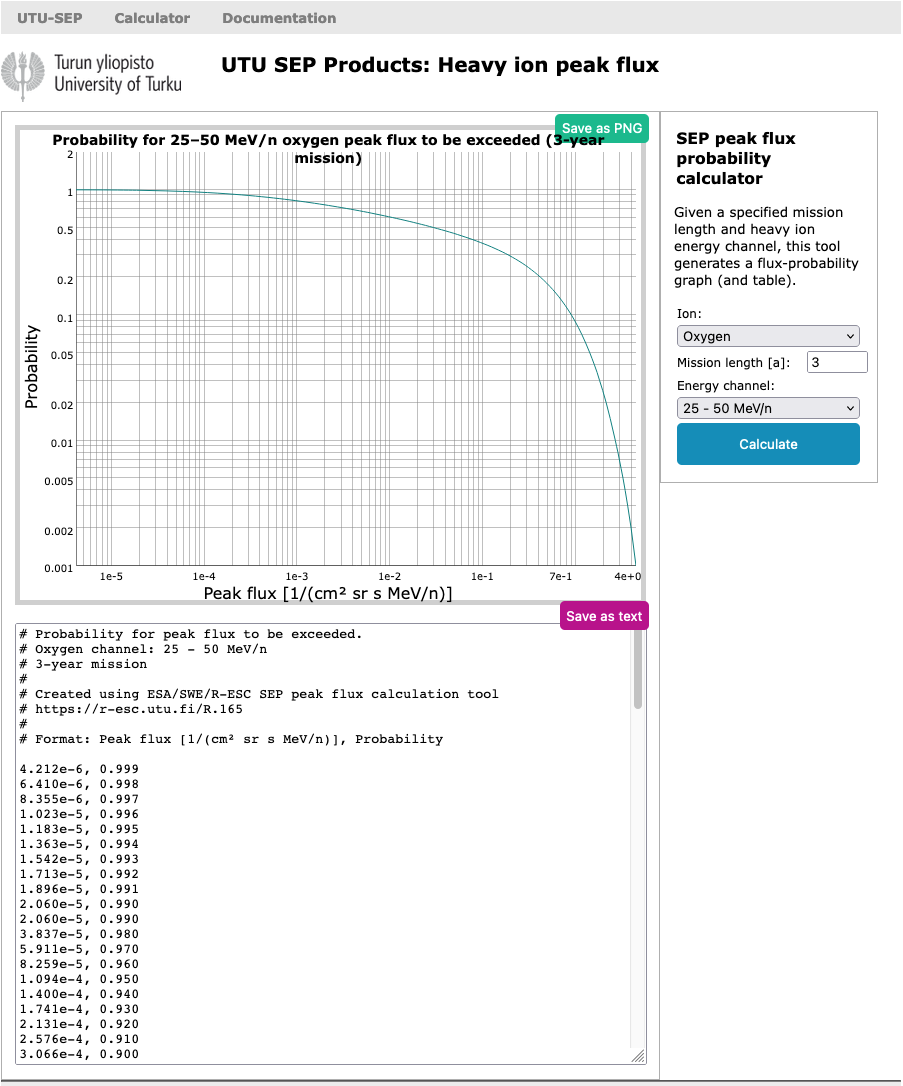
The user can hover over the plot area and read the values of the points closest to the cursor on the screen. The plot, once created, can also be saved as a PNG file using the button on the right. Alternatively, the raw data of the plot in numeric format can be copied and pasted out from the text field below the plot area, or downloaded as a text file using the "Save as text"-button.
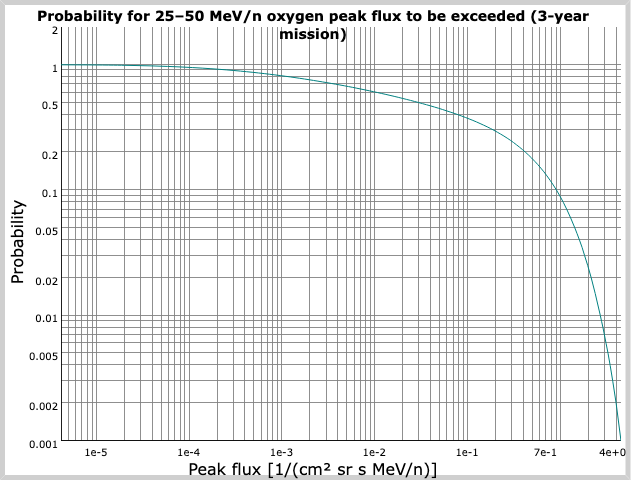
In case you click the green button to save the PNG file, either a file download dialog appears or the plot is downloaded automatically into the default download folder, depending on the browser settings. The saved plot should look like this:
Machine-to-machine interface
The machine-to-machine interface (API) to the product is provided as a web page located at
https://r-esc.utu.fi/api/R.165/probability?<parameter_list>
The <parameter_list> is explained below. The output of the API is a csv file identical to the GUI except for the header part, which is omitted.
The calculator has three parameters.
| Parameter name | Type | Range / allowed values | Description |
|---|---|---|---|
| ion | string | “helium”, “carbon”, “nitrogen”, “oxygen”, “neon”, “magnesium”, “silicon”, “sulfur”, “argon”, “calcium”, “chromium” or “iron” | Ion selector |
| mission_length | float | 0.5 — 7.0 | Mission duration in years |
| energy_channel | integer |
1, 2 or 3 for “helium”. 2 or 3 for “carbon”, “nitrogen” and “oxygen”. 3 for “neon”, “magnesium”, “silicon”, “sulfur”, “argon”, “calcium”, “chromium” and “iron” |
Energy channel index (see below for corresponding MeV/n values) |
energy_channel value index correspondence to MeV/n value:
| energy_channel | Description |
|---|---|
| 1 | 13 — 25 MeV/n |
| 2 | 25 — 50 MeV/n |
| 3 | 50 — 100 MeV/n |
For example, acquiring the iron peak flux probability distribution in energy channel 3 for a two-year mission, access the following web page:
https://r-esc.utu.fi/api/R.165/probability?ion=iron&mission_length=2.0&energy_channel=3
References
Jiggens P. et al., 2012, IEEE Transactions on Nuclear Science, 4, 59, DOI: 10.1109/TNS.2012.2198242Jiggens P. et al., 2018, Journal of Space Weather and Space Climate, 8, A31, DOI: 10.1051/swsc/2018010
Paassilta M. et al., 2017, Journal of Space Weather and Space Climate, 7, A14, DOI: 10.1051/swsc/2017013